During my first attempt using MACAU (11-diff-methyl-MACAU), I realized that generating the sample relatedness matrix from parent IDs alone led to complete nesting/collinearity of the relatedness matrix and the treatment condition.
To try to reduce this problem, I’m going to call variants from the offspring WGBS data. The SNPs can then be used to generate a more accurate relatedness matrix. They will also be important to exclude C-T SNPs, which can falsely present as an unmethylated C site (following the bisulfite conversion).
I’ll be using BS-Snper for WGBS variant calling, and referencing a past example from Yamani (accessed through the Roberts Lab Handbook)
Code available here
1 Load libraries
library(dplyr)##
## Attaching package: 'dplyr'
## The following objects are masked from 'package:stats':
##
## filter, lag
## The following objects are masked from 'package:base':
##
## intersect, setdiff, setequal, unionlibrary(tidyr)
library(pheatmap)2 Download all sample BAM files
(if needed)
# Run wget to retrieve FastQs and MD5 files
# Note: the --no-clobber command will skip re-downloading any files that are already present in the output directory
wget \
--directory-prefix ../output/02.10-bismark-deduplication \
--recursive \
--no-check-certificate \
--continue \
--cut-dirs 4 \
--no-host-directories \
--no-parent \
--quiet \
--no-clobber \
--accept="*dedup.sorted.bam" https://gannet.fish.washington.edu/gitrepos/ceasmallr/output/02.10-bismark-deduplication/
cd ../output/02.10-bismark-deduplication
echo "How many bam files were downloaded?"
ls *dedup.sorted.bam | wc -l
echo ""
echo "Check file checksums:"
grep 'dedup.sorted.bam' checksums.md5 | md5sum -c -We should have N=32 (n=15 ControlxControl crosses, n=17 ExposedxExposed crosses)
3 Merge samples
First, to ID SNPs accross all samples, for use in removing C/T transitions during methyl analysis, I first need to merge all sample BAMs into a single BAM file, which will be used as input to BS-Snper.
merge to single BAM using samtools
samtools merge \
--threads 20 \
-o ../output/12-snp-calling-BS-Snper/merged_offspring_dedup.sorted.bam \
../output/02.10-bismark-deduplication/*dedup.sorted.bam \
check
samtools view \
--threads 20 \
../output/12-snp-calling-BS-Snper/merged_offspring_threads_dedup.sorted.bam \
| head
create index file (in case I want to view in IGV)
samtools index \
-b ../output/12-snp-calling-BS-Snper/merged_offspring_dedup.sorted.bam
4 Identify SNPs across samples
Options for the script are found here and below. Input and output files should be absolute paths.
–fa: Reference genome file in fasta format –input: Input bam file (I’m using deduplicated sorted bams) –output: Temporary file storing SNP candidates –methcg: CpG methylation information –methchg: CHG methylation information –methchh: CHH methylation information –minhetfreq: Threshold of frequency for calling heterozygous SNP –minhomfreq: Threshold of frequency for calling homozygous SNP –minquali: Threshold of base quality –mincover: Threshold of minimum depth of covered reads –maxcover: Threshold of maximum depth of covered reads –minread2: Minimum mutation reads number –errorate: Minimum mutation rate –mapvalue: Minimum read mapping value SNP.out: Final SNP result file ERR.log: Log file
#Defaults: --minhetfreq 0.1 --minhomfreq 0.85 --minquali 15 --maxcover 1000 --minread2 2 --errorate 0.02 --mapvalue 20
#Saving output to gannet
/home/shared/BS-Snper-master/BS-Snper.pl \
--fa ../data/Cvirginica_v300/Cvirginica_v300.fa \
--input ../output/12-snp-calling-BS-Snper/merged_offspring_dedup.sorted.bam \
--output ../output/12-snp-calling-BS-Snper/SNP-candidates.txt \
--methcg ../output/12-snp-calling-BS-Snper/CpG-meth-info.tab \
--methchg ../output/12-snp-calling-BS-Snper/CHG-meth-info.tab \
--methchh ../output/12-snp-calling-BS-Snper/CHH-meth-info.tab \
--mincover 5 \
> ../output/12-snp-calling-BS-Snper/SNP-results.vcf 2> ../output/12-snp-calling-BS-Snper/merged.ERR.log
5 Identify SNPs per-sample
To call per-sample variants (to ultimately generate a relatedness matrix), I need to run BS-Snper separately one each sample BAM. Since there are >30 samples, want to parallelize this to save time.
mkdir -p ../output/12-snp-calling-BS-Snper/per-sample

# function to run BS-Snper once
run_bssnper() {
  bam=$1
  s=$(basename ${bam} _dedup.sorted.bam)
  ~/BS-Snper-master/BS-Snper.pl \
    ${bam} \
    --fa ../data/Cvirginica_v300/Cvirginica_v300.fa \
    --output ../output/12-snp-calling-BS-Snper/per-sample/${s}.candidates.txt \
    --methcg ../output/12-snp-calling-BS-Snper/per-sample/${s}.CpG.tab \
    --methchg ../output/12-snp-calling-BS-Snper/per-sample/${s}.CHG.tab \
    --methchh ../output/12-snp-calling-BS-Snper/per-sample/${s}.CHH.tab \
    --mincover 5 \
    > ../output/12-snp-calling-BS-Snper/per-sample/${s}.vcf 2> ../output/12-snp-calling-BS-Snper/per-sample/${s}.err.log \
  && rm ../output/12-snp-calling-BS-Snper/per-sample/${s}.candidates.txt ../output/12-snp-calling-BS-Snper/per-sample/${s}.C*.tab
}
export -f run_bssnper

# list out all of the sample BAM files, then feed into function run_bssnper using `parallel` to parallelize
ls ../output/02.10-bismark-deduplication/*_dedup.sorted.bam | parallel -j 20 --joblog ../output/12-snp-calling-BS-Snper/per-sample/parallel.log run_bssnper {}
6 Merge vcf files
Now that I have a variant file for each sample, combine into single file for conversion to relatedness matrix
File should end up as a multi-sample .vcf.gz file, which has one row per SNP position, one genotype column per sample.
cd ../output/12-snp-calling-BS-Snper/per-sample

# For each sample's output .vcf file, pull the sample name and rewrite file header
# to include unique sample ID and chromosome names/lengths (required for BS-Snper)
# Also compress to .vcf.gz file type, which is required to merge all files using `bcftools` merge
for vcf in *.vcf; do
  s=${vcf%.vcf}
  echo ${s} > ${s}.name
  /home/shared/bcftools-1.14/bcftools reheader -s ${s}.name --fai ../../../data/Cvirginica_v300.fa.fai ${vcf} \
    | /home/shared/bcftools-1.14/bcftools view -f PASS -Oz -o ${s}.vcf.gz
  /home/shared/bcftools-1.14/bcftools index ${s}.vcf.gz
done

# merge all files using `bcftools` merge
ls *.vcf.gz > vcf_list.txt
/home/shared/bcftools-1.14/bcftools merge -l vcf_list.txt -Oz -o merged.vcf.gz
Filter to keep:
- only biallelic sites
- only single base substitutions (SNPs)
- only sites with genotypes in at least half of the samples
- only sites where the rarer allele is at a frequency of at least 5% (rare variants not super useful for relatedness estimaes, add noise)
cd ../output/12-snp-calling-BS-Snper/per-sample

/home/shared/bcftools-1.14/bcftools view -m2 -M2 -v snps merged.vcf.gz \
  | /home/shared/bcftools-1.14/bcftools view -i 'F_MISSING < 0.5 && MAF > 0.05' -Oz -o merged.filtered.vcf.gz
Use plink to build the relatedness matrix (MACAU reccommends using GEMMA, but we already have plink installed on Raven at /home/shared/plink_linux_x86_64_20230116/plink)
--allow-extra-chr : plink expects human-style chromosomes, need this option to permit the oyster chromosomes
/home/shared/plink_linux_x86_64_20230116/plink --vcf merged.filtered.vcf.gz \
  --allow-extra-chr --double-id \
  --set-missing-var-ids @:# \
  --make-rel square \
  --out relatedness
Build a heatmap showing the sample relatedness
rel_dir <- "../output/12-snp-calling-BS-Snper/per-sample"

# read in relatedness matrix
rel <- as.matrix(read.table(file.path(rel_dir, "relatedness.rel")))

# read sample ids from the helper doc
ids <- read.table(file.path(rel_dir, "relatedness.rel.id"))$V2
dimnames(rel) <- list(ids, ids)

# Parse annotations from sample names
# (e.g., "CF01-CM01-Zygote" used to pull Control and Zygote)
parts <- do.call(rbind, strsplit(ids, "-"))
annot <- data.frame(
  Stage     = parts[, 3],
  Treatment = substr(parts[, 1], 1, 1),   # C or E
  row.names = ids
)

# Build heatmap
pheatmap(rel,
         annotation_row = annot,
         annotation_col = annot,
         color = colorRampPalette(c("#2166ac", "white", "#b2182b"))(100),
         breaks = seq(-max(abs(rel)), max(abs(rel)), length.out = 101),
         fontsize_row = 7, fontsize_col = 7,
         main = "Genomic relatedness (PLINK --make-rel)")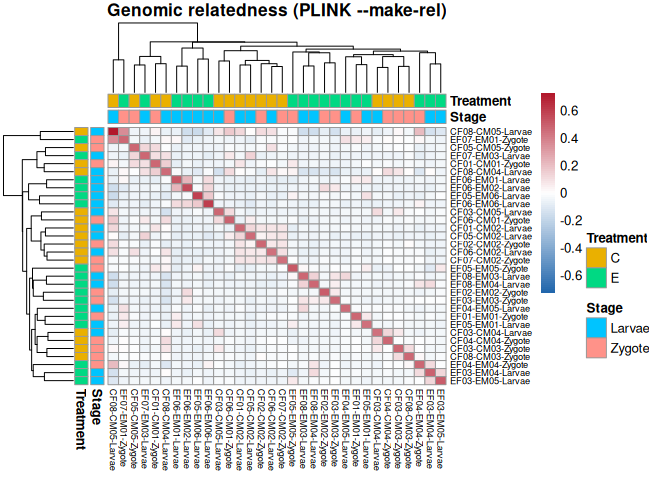
Looks good! Half-sibs are grouped together, as expected, and grouping is associated with neither treatment nor stage, which is also great! Only confusing thing is why CF08-CM05-Larvae and EF07-EM01-Zygote are so closely related…
It could just be because one of those samples has extremely low coverage, and they share a relatively high proportion of SNPs by chance (CF08-CM05-Larvae only has 6.2 million C’s, compared to >200 million in most samples)